
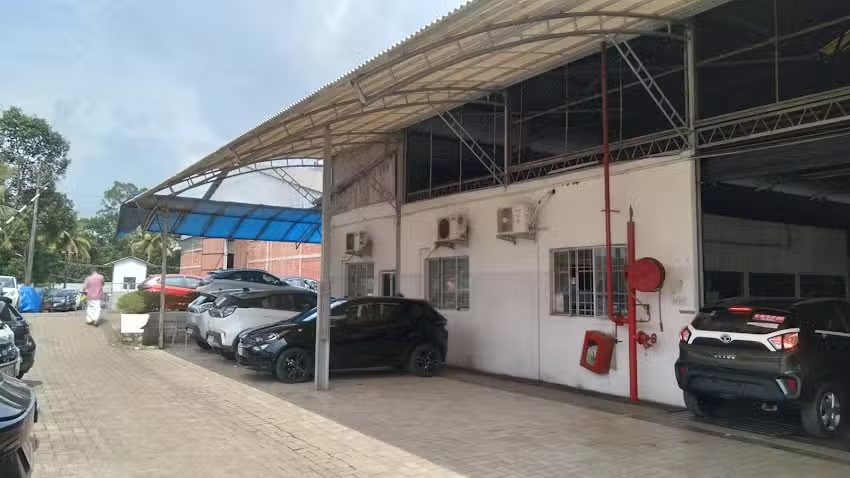
Tata Motors Cars Service Centre – MK Motors, Channanikadu
BackFormerly a key destination for Tata vehicle owners in the Kottayam district, the Tata Motors Cars Service Centre operated by MK Motors in Channanikadu is now permanently closed. For years, it served as the primary facility for vehicle maintenance and repairs for a growing number of Tata car owners in the region. However, a comprehensive analysis of its operations, based on extensive customer feedback and its final standing, reveals a business that struggled with fundamental issues of location, efficiency, and customer management, culminating in its eventual closure.
The Duality of Service: A Tale of Two Experiences
The service center's reputation was decidedly mixed, a fact reflected in its 3.5-star rating aggregated from nearly a thousand reviews. This score suggests that for every satisfied customer, there was likely another who left disappointed. On one hand, the facility itself was praised for its scale. It was described as a "huge service area," which on paper should have translated to efficient workflow and capacity. Some customers recounted positive interactions, noting that service advisors could be prompt in receiving vehicles and were willing to explain the necessary car repair work. This indicates that pockets of good customer service existed within the organization.
Conversely, a significant number of patrons faced a litany of frustrations that overshadowed any positive attributes. These issues were not isolated incidents but recurring themes that pointed to systemic problems in the center's operational model. The story of MK Motors is one of a business with potential that was ultimately undermined by its own shortcomings.
The Challenge of Location and Accessibility
One of the most persistent complaints leveled against the MK Motors service center was its inconvenient location. Situated on the outskirts of Kottayam city in Channanikadu, it was disconnected from the main town, making it a difficult place to travel to and from. Customers frequently mentioned the lack of connectivity, which turned a simple car drop-off into a logistical challenge. For those who chose to wait while their vehicle underwent scheduled maintenance, the remote location meant being stranded for hours with few alternatives. While the center offered a pick-up and drop-off service, this seemed more a mandatory fix for a flawed location choice than a value-added convenience. This single factor heavily impacted the customer experience, forcing patrons to dedicate an entire day, often from 9 AM to 5 PM, for a standard service, a time commitment that many found excessive.
Operational Inefficiencies and Extended Wait Times
Beyond its location, the core operations of the Tata service center were a significant source of customer dissatisfaction. A recurring issue was the extremely long turnaround times. Many reviews highlighted that the center seemed to take on more bookings than it could handle, leading to a bottleneck where customers' vehicles would wait for extended periods before work even began. One customer's experience of traveling 50 kilometers for a pre-confirmed appointment, only to be told it wasn't in the system, exemplifies a catastrophic failure in administrative processes and respect for the customer's time.
Observations from patrons suggested that these delays were partly due to outdated practices. One detailed review pointed out a noticeable lack of modern equipment, such as pneumatic tools, with technicians relying on older, less efficient methods. This not only slowed down the auto repair process but also raised questions about the center's investment in technology to keep pace with modern automotive standards. The suggestion from a customer that technicians needed "lean training sessions" to improve skill and speed highlights that the inefficiency was visible even to the untrained eye. These operational drags directly contributed to the long waits and likely impacted the quality of the automotive repair work itself.
A Closer Look at the Customer Journey: Pros and Cons
To better understand the inconsistent experiences at MK Motors, it's helpful to break down the journey into distinct positive and negative aspects based on collective feedback.
- The Positives:
- Spacious Infrastructure: The physical size of the service bay area was impressive, suggesting it was built to handle high volume.
- Helpful Individual Staff: Despite management-level issues, some service advisors were commended for their attentiveness and clear communication during the initial vehicle intake.
- Signs of Improvement: At least one long-term customer noted that service quality had shown some improvement over time, indicating that efforts were being made, even if they were ultimately insufficient.
- The Negatives:
- Poor Booking Management: The system for scheduling appointments was clearly unreliable, leading to severe inconveniences and a breakdown of trust.
- Excessive Service Time: A routine service with a car wash could consume an entire workday, a duration far beyond industry standards.
- Outdated Technology and Methods: A lack of investment in modern tools hampered technician efficiency and contributed to delays in services like engine diagnostics and general repairs.
- Irresponsible Management: The sentiment that management was irresponsible was explicitly stated, pointing to a leadership failure in addressing the persistent operational flaws and poor customer service in the lounge area.
The Inevitable Outcome: Closure and Lessons Learned
The permanent closure of the MK Motors car service center in Channanikadu can be seen as the logical conclusion of its operational struggles. A business model dependent on customer volume cannot sustain itself when plagued by an inconvenient location, inefficient processes, and unreliable administrative support. The consistent feedback regarding long waits and booking failures likely led to a decline in customer loyalty, as Tata owners sought more reliable and convenient alternatives for their car repair and maintenance needs. The mediocre 3.5-star rating was a clear indicator of widespread, unresolved issues.
The constructive criticism offered by former customers serves as a valuable case study. Suggestions for a shuttle service to key transport hubs, investment in modern tools, and better training for technicians were practical solutions that could have addressed the core problems. The desire for direct communication with technicians for complex repairs also points to a need for greater transparency in the auto repair process. Ultimately, the failure to adapt and rectify these fundamental flaws created an unsustainable business environment. For Tata vehicle owners in the Kottayam area, the closure leaves a service gap, but for the automotive industry, it stands as a clear lesson: infrastructure and brand affiliation are not enough. Success in the car service industry is built on a foundation of customer respect, operational efficiency, and unwavering reliability.
